Below is a graphic that displays various statistics of the consumption of pornography, most of which is produced in the United States.
Tomorrow, I’ll discuss why internet filters are a must for ALL families!

Sexual Purity Support & Recovery Group
Below is a graphic that displays various statistics of the consumption of pornography, most of which is produced in the United States.
Tomorrow, I’ll discuss why internet filters are a must for ALL families!
We Humbly Ask God to Remove All Our Shortcomings.
“If we confess our sins, he is faithful and just and will forgive us our sins and purify us from all unrighteousness.” (1 John 1:9)
In step 4, we listed our character defects, in step 5, we admitted them to God, to ourselves, and to another human being, and in step 6, we became entirely ready for God, not us, to remove our defects of character. Now, in step 7, we ask God to remove all of our shortcomings and we do it humbly.
So what does it mean to be humble? Of course, as an engineer, I have to list the definition so as to avoid confusion:
hum·ble/ˈhəmbəl/
Adjective: Having or showing a modest or low estimate of one’s own importance.
Verb: Lower (someone) in dignity or importance: “I knew I had to humble myself to ask for His help”.
In understanding what humble really means, I was able to really submit to God by lowering  my own importance well beneath that of God’s importance. In my addiction, Sexual acting out was my “god” and I was it’s only begotten son. I was the most important man in my life, I did not care about others, only about my own sexual satisfaction or own personal wants. After I hit rock bottom and I saw my powerless over sexual acting out and how crazy my life had become I began the process of becoming humble; well, actually God began that for me. I then saw how insane my behavior truly was, I needed help from my higher power, in my case God thus lowering my own importance compared to Him and to others around me. I then went on to give myself to Him on a daily basis, not always perfect, but progressing in the process of turning my life and will over to God’s care. And then I did my internal search and saw who I really had become. I listed my character defects and all my wrongs and I really knew I needed His help.
As an addict, I am too familiar with humiliation so I must distinguish between humility and humiliation. The SAA Green Book defines humility as being teachable, vulnerable, and open. I need to be open to new ways of thinking and new ways of living my life. I need to be teachable and learn these new ideas as well as emotionally vulnerable to others, asking for their help as my recovery continues. Humility, for me, is not walking up steps on my bare knees to show that I a humble worshiper, it is not dragging a 200lb+ cross on my back as I whip myself (or others whip me) with torture whips from the Roman Empire era. The latter two seem more like humiliation … to me.
Just asking for help from others is an act of humility and of being humble. Understanding that I can’t do this by myself is a wonderful gift; it feels great to know that I am not all powerful and I need help, every day. I also have come to the understanding that change occurs on God’s time, not mine. As an addict, I was used to the quick fix, the instant gratification, the quick escape. In my early recovery, I felt the same could be done for my healing; quick and easy with no pain or suffering! I was very, very wrong! I often commented how I would have entered recovery 10+ years earlier than I did and the comments I received back after many meetings was, “it’s all in God’s time, not ours.” It took me working through my own recovery to really realize that everything happens on God’s time, when God says the time is right, not when I say it is. I also need to keep in mind that I need not be concerned with the results, all I need to do is ask.
One of my favorite ways God works in my life is through other people in and outside of recovery. I often state in my weekly Bible reading group that God uses men (and women) around us to speak to us. Sometimes these people “tell it like it is” and point out to me a character defect that has risen up, which in turn allows me to be entirely ready and then humbly ask God to remove it! There are many other ways God uses people to do His work in our lives, but that is subject for another post.
It isn’t until we have looked at all these character defects and humbly asked God to remove them that we are ready to repair any harm we have done in the past. If we do not look closely at these character defects, they might come forward during our amends, things like pride, resentment, fears, etc… might interfere with our Step 8. So it is important to be in a place in our recovery where we can have these character defects removed (even just temporarily enough) so we can move forward and make the list of the persons we had harmed, without having these all too familiar character defects pop up and interfere with the recovery process.
Take what you like and leave the rest.
In today’s topic I read from the Twelve Steps for Christians and the SAA Green Book
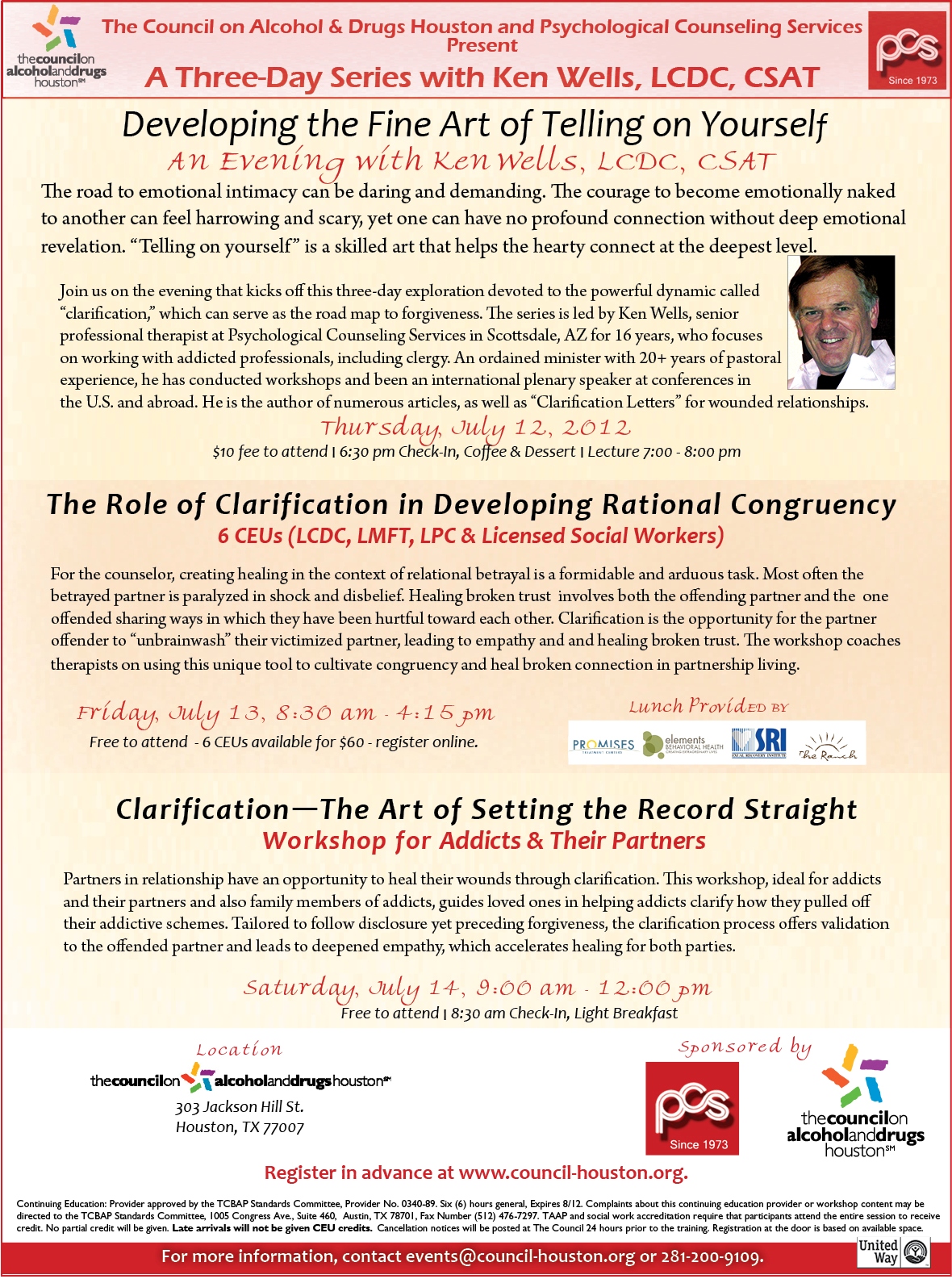 Evening with Ken Wells
Thursday, July 12, 2012 6:30 PM to 8:00 PM
Cost: $10
6:30 p.m. Check-in, coffee & dessert
7 – 8 p.m. Presentation
Location: The Hamill Foundation Conference Center
The Council on Alcohol & Drugs Houston
303 Jackson Hills Street
Houston, TX 77007
Contact: 281.200.9109 or events@council-houston.org
——————————————————————->
Click on the Flyer to the right for more information
To register online, click the link below:
https://28052.thankyou4caring.org/sslpage.aspx?pid=483
KEN WELLS is a certified professional counselor specializing in treating sexual addiction and the treatment of sexual offense behavior at Psychological Counseling Services in Scottsdale, Arizona. He served for more than 20 years as a pastor. He and his wife Eileen have three children. He’s a founding member of Interfaith Sexual Trauma Institute and serves on the executive board of New Hope Educational Foundation.
I really liked this episode of Facing Life Head-On that interviews Shelley Lubben and Noel Bouché speaking out about the reality of the sex industry, from prostitution and pornography to sex trafficking.
“Prostitution, Pornography, and the Sex Industry don’t often come up in polite conversation, but we live in a sex-saturated society. My guests today, point out it is adversly affecting future generations. They say it is something we should be talking about.” – Brad Mattes
“When you bring people together in an authentic way and talk about human sexuality, you begin to see power; you begin to see movement.” – Noel Bouché
“God might be using a porn addiction to bring people to their knees.” – Shelley Lubben
http://www.facinglife.tv/episode/satans-final-frontier-the-sex-industry-needs-youtube-link/
Denial
Denial is a very interesting thing. How do we know we are in denial if we are in denial? The definition of the word denial is written below.
Denial
de·ni·al [dih-nahy-uhl] noun
1. an assertion that something said, believed, alleged, etc., is false: Despite his denials, we knew he had taken the purse. The politician issued a denial of his opponent’s charges.
2. refusal to believe a doctrine, theory, or the like.
3. disbelief in the existence or reality of a thing.
4. the refusal to satisfy a claim, request, desire, etc., or the refusal of a person making it.
5. refusal to recognize or acknowledge; a disowning or disavowal: the traitor’s denial of his country; Peter’s denial of Christ.
These are great definitions of denial but don’t clearly fit my idea of denial when it comes to addiction so I choose to look at Wikipedia for their description:
Denial (also called abnegation) is a defense mechanism postulated by Sigmund Freud, in which a person is faced with a fact that is too uncomfortable to accept and rejects it instead, insisting that it is not true despite what may be overwhelming evidence.
 The above is a much better description of the type of denial to which I am referring. When a person enters real recovery, they leave the state of denial that left them in their addiction. However, for some who believe they are in recovery, they continue to deny or minimize the addiction to certain sexual behaviors allowing them to prolong or feed the addiction. Until the sexual addict fully steps out of denial, practicing rigorous honesty, and accepts their compulsive sexual behavior as fact, they will not find help, freedom, or sobriety from their addictive behaviors.
Per Wikipedia:
The concept of denial is important in twelve-step programs, where the abandonment or reversal of denial forms the basis of the first, fourth, fifth, eighth and tenth steps. The ability to deny or minimize is an essential part of what enables an addict to continue his or her behavior despite evidence that—to an outsider—appears overwhelming. This is cited as one of the reasons that compulsion is seldom effective in treating addiction—the habit of denial remains.
To remain in denial is to remain in the addiction. Making excuses or defending the use of pornography, for example, is a great case of denial for a sexual addict. Until the addict realizes how addictive the chemical high produced by the brain during the viewing of pornography can really be, they will continue to slip and slide in their recovery (although deny that they have slipped or relapsed). Quite a few have made excuses for the occasional use of pornography in their “recovery” or acceptance of such material as “allowed” in order to not feel shame or guilt because of viewing the material. It is my opinion that this mentality, does not, and will not lead to sexual sobriety and instead will lead the addict back into compulsive sexual behaviors. Another point of denial is the recovering sex addict that believes they can visit an adult oriented business, such as a strip club or adult book store, with “look but don’t touch” mentality. This, again, is an example of making excuses and living in the addiction and in denial. It is very important to be connected with a sponsor or someone else in recovery who can review our sexual behaviors especially if we use the “three circle” method used in Sex Addicts Anonymous (SAA).
In using the three circles, we might feel that we are “ok” by living in middle circle activity when in fact we should not even be engaging in that type of activity! A sponsor can carefully evaluate the activity and see if we are in denial about our acting out and whether the activity needs to be moved into inner circle behavior. Remember, the middle circle is for our protection to keep us away from compulsive sexual behaviors. However, no activity in the middle circle should be “acceptable” and engaging in behaviors in the middle circle should sound alarms that something is not right in our recovery or life! A more thorough analysis of the three circles will be made in a future blog post.
One of my favorite explanations of denial is an acrostic/acronym I once heard in a recovery meeting.
DENIAL – Don’t E ven kNow I Am Lying
 When we work our Steps 1 and 4, we can see where we consistently lied to ourselves about issues concerning our compulsive sexual behavior to the point that we didn’t even realize that we were lying! Compulsive sexual behavior became so ingrained in our lives that we saw it as truth and excused our actions with “everybody does it,” regardless of how insane our behaviors became. In working a Step 5, we receive help from our sponsor and the Holy Spirit in further stepping out of any denial that may remain in our addictive sexual behavior. Our sponsor and conviction by the Spirit can help point out parts of our lives where we may still live in denial of certain character defects or activities. Then, we can step out of denial and realize that we had been lying to ourselves the entire time; we can begin to live in the truth!
It isn’t until we step out of our denial of our addiction and compulsive sexual behaviors and all activities associated with the behavior that we can fully enter a manner of living honestly and fully enter recovery as a lifestyle. When we fully enter recovery, we relocate; we not longer live in the great State of Denial!
Take what you like and leave the rest.
This site is intended for individuals who struggle with maintaining sexual purity. This information is posted for individuals at various stages in their recovery, year 1 to year 30+; what applies to some, may not apply others. Spouses are encouraged to read this blog with the caveat that they may not agree with, understand, or know the reason for some items posted. As always, take what you like and leave the rest.
