• Skip to main content
  • Skip to footer

CASTIMONIA

Sexual Purity Support & Recovery Group

  • Home
  • About Castimonia
    • Statement of Faith
    • Member Struggles
    • Are You a Sex Addict?
    • About the Leaders of Castimonia
  • Meetings
    • What to Expect at a Castimonia Meeting
    • Meeting Times & Locations
      • Alaska Meetings
      • Arkansas Meetings
      • Mississippi Meetings
      • New York Meetings
      • Ohio Meetings
      • Tennessee Meetings
      • Texas Meetings
      • Telephone Meeting
      • Zoom Online Meetings
  • News & Events
  • Resources
    • Books
    • Document Downloads
    • Journal Through Recovery
    • Purity Podcasts
    • Recovery Videos
    • Telemeeting Scripts
    • Useful Links
  • Contact Us

sex partners

February 9, 2014 By Castimonia

Ten Things You Might Not Know About Men Who Buy Sex

In a comprehensive study, “Comparing Sex Buyers with Men Who Don’t Buy Sex,” Melissa Farley, PHD, Founding Director of the Prostitution Research and Education, compares the characteristics of men who buy sex versus those who don’t. Besides their involvement with prostitution, the men surveyed revealed surprising attitudes and behaviors when it came to sex and women. Here are ten things you may not know about men who buy sex:

  1. On average, men reported were 21 years of age when they first bought sex.
  2.  25% of the sex buyers had traveled to another state and while there used women in prostitution.
  3.  41% of the sex buyers knowingly used a woman in prostitution who was controlled by a pimp.
  4. 66% of the sex buyers observed that a majority of women are lured, tricked or trafficked into prostitution.
  5. 74% of the sex buyers reported that they learned about sex from pornography.
  6. Sex buyers were more than 7x’s more likely than non-sex buyers to acknowledge that they would rape a woman if they could get away with it and if no one knew about it.
  7. Sex buyers are far more likely than non-sex buyers to commit felonies, misdemeanors, crimes related to violence against women, substance abuse-related crimes, assaults, crimes with weapons, and crimes against authority.
  8. 89% of sex buyers said they would be deterred from buying sex if their name were to be added to a sex offender registry.
  9. 90% of sex buyers said they would be deterred from buying sex if a $1,000-$2,000 penalty were imposed.
  10. 100% of sex buyers said they would be deterred from buying sex if a one month jail term were imposed.
Filed Under: Sexual Purity Posts Tagged With: addiction, affair, Affairs, anonymous sex partners, call girls, castimonia, christian, escorts, father wound, gratification, healing, human trafficking, Intimacy, Jesus Christ, lust, masturbation, porn, porn star, pornography, pornstar, pornstars, prostitute, prostitutes, ptsd, purity, recovery, Sex, sex addict, sex addiction, sex partners, sexual, sexual addiction, sexual impurity, sexual purity, spouses, STD, strippers, trafficking, trauma

February 7, 2014 By Castimonia

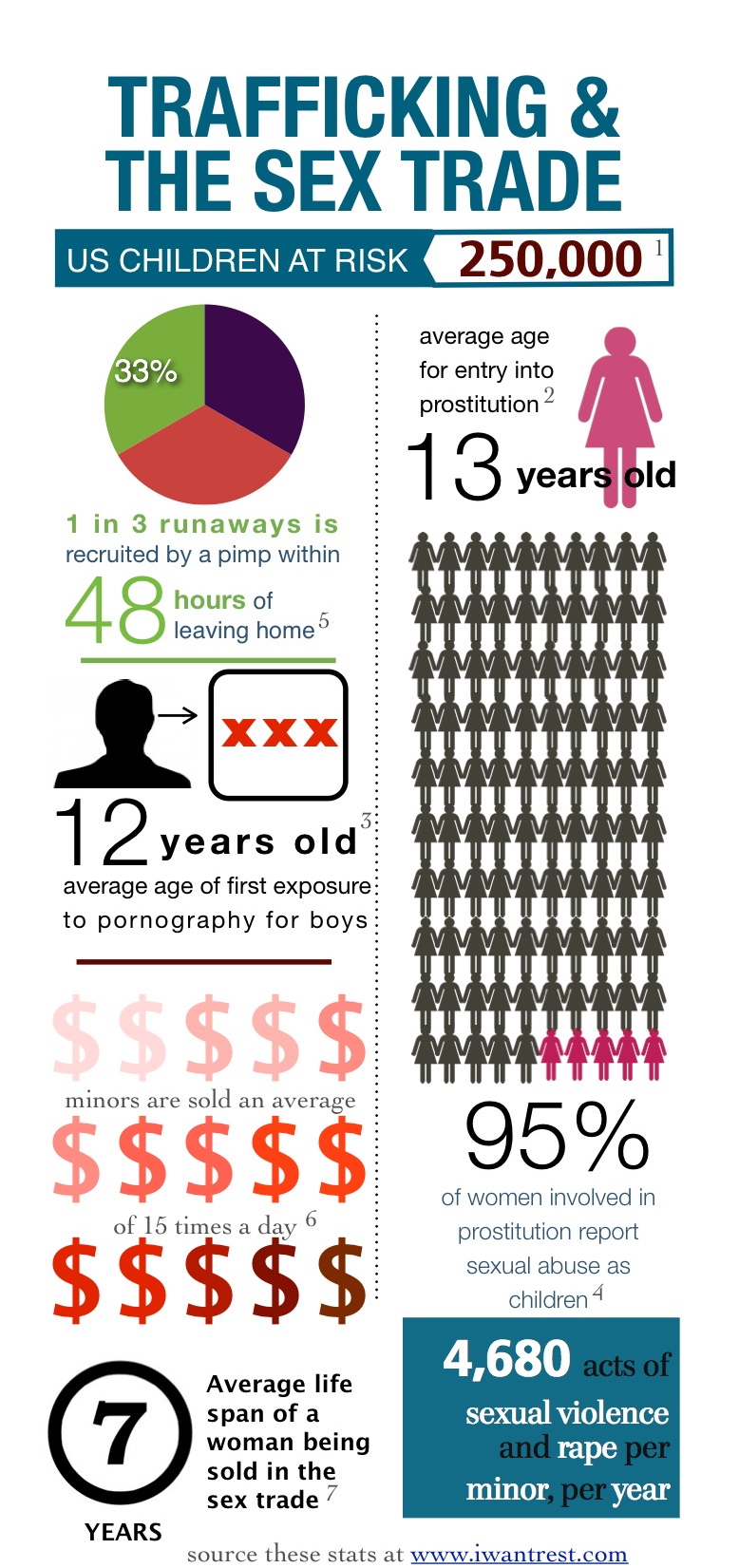
Trafficking & The Sex Trade

0001EL1 1. Estes, Richard J. and Neil A. Weiner. The Commercial Sexual Exploitation of Children in the U.S., Canada, and Mexico. The University of Pennsylvania School of Social Work: 2001 2. Estes, Richard J. and Neil A. Weiner. The Commercial Sexual Exploitation of Children in the U.S., Canada, and Mexico. The University of Pennsylvania School of Social Work: 2001. 3. Brown, Jane D., and Kelly L. L’Engle. “X-rated sexual attitudes and behaviors associated with US early adolescents’ exposure to sexually explicit media.” Communication Research 36.1 (2009): 129-151. 4. Debra Boyer, U. Washington, Susan Breault of the Paul & Lisa Program, “Danger for prostitutes increasing, most starting younger,” Beacon Journal, 21 September 1997 5. National Runaway Switchboard, August 2006 6. Shared Hope International 7. FBI, 2011

Filed Under: Sexual Purity Posts Tagged With: addiction, affair, Affairs, anonymous sex partners, call girls, castimonia, child abuse, childhood abuse, childhood sexual abuse, christian, escorts, father wound, gratification, healing, human trafficking, Intimacy, Jesus Christ, lust, masturbation, porn, porn star, pornography, pornstar, pornstars, prostitute, prostitutes, ptsd, purity, recovery, Sex, Sex Abuse, sex addict, sex addiction, sex partners, sexual, sexual abuse, sexual addiction, sexual impurity, sexual purity, spouses, STD, strippers, trafficking, trauma

February 5, 2014 By Castimonia

How to Survive Infidelity

Originally posted at: http://www.affairrecovery.com/newsletter/founder/how-to-survive-infidelity

Rick Reynolds

Rick Reynolds
Founder & President Affair Recovery

The discovery of infidelity not only severely disrupts your life, but is a violation unlike  any other event. Most experts who deal with infidelity say that the betrayed spouse deals with anywhere from 50 to 100 different reminders and triggers about their spouse’s infidelity daily.  At the same time we have a God who is far bigger than our circumstances. As those of us who have traveled this road and have experienced true restoration can attest, the marriage we now experience is far better than what we once had or even thought we could have. What I heard Rick Reynolds say some time ago is absolutely true: you can never tell the end of the story by the beginning. I encourage you to stay the course and see what is possible with the right kind of help and support to survive infidelity.

Over the years I have found that hearing a similar story to your own to be not only reassuring but instrumental for healing and perspective. When Rick asked me to share my story, I wondered what I could offer in terms of providing hope for those who will one day have to live through this nightmare.  As I began to go deeper into my personal experience, I felt the need to share some very practical, yet life changing suggestions which I hope and pray help you as much as they helped me.

6 Tips for the Unfaithful Spouse

  1. You must stop the affair. You will need help to stop it. Find an experienced professional, spiritual leader, or someone who has lived through this type of situation. Getting the right kind of help from those who have gone through it before is critical to finding momentum in your recovery. If you’re reading this, you’ve probably realized your own efforts were not sufficient to prevent the affair and doing more of the same won’t be sufficient as you move forward to survive infidelity.
  2. Commit to creating an atmosphere of safety. Commit to openness and honesty on a daily basis. Be available by cell phone. Be willing to call from a land line (to show where you are). Hand over all passwords, e-mail addresses, bills, and give access to your mate in order to give him/her assurance. Make a decision to have no unaccounted for time in your day. If you’re going to give this marriage a shot at being restored, be willing to do whatever it takes to restore trust. The way to reestablish trust is to first trust your mate with what’s going on in your life.
  3. Take responsibility. As bad as your marriage may have been, and as rejected as you may have felt, it still doesn’t justify breaking a vow. Have the courage to say “I messed up.” Take responsibility for your own recovery.
  4. Develop empathy for your spouse. Daily express to your mate that you’re sorry for the pain that you have caused and/or appreciation that your mate is still there. Being able to express grief over what your actions have cost your mate is one of the first and most important steps to moving beyond the betrayal.
  5. Be patient and ask your mate how he/she is doing. If you see your mate is down, simply ask how he/she is feeling. Our first tendency when we see those storm clouds brewing over our mate is to run for the shelter, but in recovery, it’s best to be a tornado chaser by creating space to share about the pain.
  6. Don’t be defensive. Usually defensiveness sounds like, “well if you hadn’t…” We often times blame our mate and try to justify why we messed up. This defensiveness and attempts at justifying our infidelity only adds to the frustration, hurt and anger.

5 Tips for the Betrayed Spouse

  1. Express your feelings and thoughts without the destructiveness of rage. This one can be tricky, and is especially difficult if you are very early on into discovery. It will be somewhat easier if you are able to maintain the perspective that anger (even the rage you may currently be experiencing) is a secondary emotion. Instead of expressing your anger, talk more about the underlying feelings that evoked the anger. The underlying emotions might be hurt or fear.
  2. Avoid rapid-fire questioning. Ask questions slowly, always asking yourself if the answer will be information you want to live with the rest of your life, and possibly have a reminder and/or trigger attached to it. I would encourage you to avoid questions that paint a picture in your head. These comparison questions create the intrusive thoughts you’ll later have to deal with. Ask yourself if the questions you’re asking are helping you move forward or if it is for some other reason.
  3. Commit to forgiveness. This doesn’t have to happen fast, but for your sake you want it to occur. Don’t fall into the trap of believing you can control your mate’s behavior by not forgiving. Remember, forgiveness is a gift you give yourself. Forgiving isn’t necessarily the same as reconciliation, but if your mate is safe enough it paves the way for the possibility of reconciliation.  Forgiveness is also not a one time act. There will be layers to your pain which will necessitate a commitment, in advance, to forgive as you move forward.
  4. Allow yourself time and space to grieve and process what has happened. To attempt to heal the marriage too quickly can be devastating and is one of the leading factors of relapse for the unfaithful spouse. As Leslie Hardie says, “it’s not about the amount of time you give it, rather it’s about how you utilize the time you give it.”
  5. Recognize your vulnerabilities. Don’t let your hurt, pain, and anger drive you to behaviors and choices you will later regret. Avoid putting yourself in vulnerable situations.

5 Tasks for the Couple

  1. Find support. Try to find at least two or three people you can both agree would be safe individuals to share with. Having a safe place to process feelings, apart from the marriage, can be beneficial. It’s helpful for you to have someone of the same sex you can vent to and grieve with who is safe and has your best interests at heart. Your mate absolutely needs a trusted friend where they can do the same. If you don’t have this outlet outside the marriage, chances are painful emotions will build up and come out in destructive ways.
  2. Separate the marriage from the train wreck of the infidelity. Remember, there is more to your relationship than the infidelity. The infidelity does not rewrite your whole history, although sometimes it may feel like it does. While you can never go back to what you had, you do have the opportunity for something better.
  3. Make time to talk about the marriage and the effects of the infidelity. One of the worst mistakes you can make is to stop the dialogue about what has happened. If you cannot process through the effects of the infidelity, it will most assuredly stall your efforts to heal as a couple and create underlying dissention in your heart towards your spouse. Allow time for both of you to process what you are learning about yourselves and each other along the way.
  4. Arrange a problem-free time during which you have fun and enjoy each other. This is a must, otherwise you will begin to feel like your identity and your relationship are just byproducts of the infidelity. Remember, there is more to life. So try to find times where you don’t discuss the infidelity.
  5. Remind yourself and each other that your relationship can be better. You are building honesty and empathy that were probably not there before the infidelity. Your relationship will emerge from this so much better, if you let it. It will never be the same, but who wants to go back to the lie you were living? This is an opportunity to build a new foundation, with new patterns of behavior.

Affair Proofing Your Marriage

While you cannot affair proof your marriage, you can and must, affair proof your own life. This goes for the betrayed spouse too, who in many ways is ripe for an affair if healing does not take place for the trauma after the affair. This must be a vital step the unfaithful spouse takes charge of if they are going to prevent relapse and eventually reestablish trust with their mate.

  1. Assume that an affair could happen again and take precautions, rather than assuming it will never  happen again. Actively avoid putting yourself in harm’s way. Together with your mate, design “our rules” for keeping your relationship safe.
  2. Both parties need to understand that temptations don’t define us and behavior does not equal motive. We have to be willing to be honest about dangerous situations around us. Understand that if your mate is willing to share something that he/she is struggling with, then your mate is choosing to keep the marriage safe rather than to endanger it by hiding struggles or weaknesses.
  3. Commit to work hard at your marriage. Marriages take work. Be willing to put as much time into the marriage as you do into other activities which you love. The grass isn’t greener on the other side of the hill, it’s greener where you water it.
  4. Be willing as a couple to talk about this issue. Be willing to honestly discuss any areas where the relationship is at risk, rather than just going through the emotions of it all. Auto pilot seldom works in recovery.
  5. Give back. If you’ve already recovered from a betrayal, be willing to give back to others who are still dealing with infidelity. There is no better preventive medicine than working with others who are coming along behind you. Their journey will be a constant reminder of the cost you incurred and experienced in your own journey.

There is truly nothing that the nearness of God cannot heal. The tasks on this list are just a few suggestions that will help you find and protect hope and safety in your marriage.

For more practical advice on how to survive infidelity listen to:

Affair Recovery Webinar pt.1

Affair Recovery Webinar pt.2

and receive a free copy of a two hour webinar featuring leading experts in the field of infidelity recovery. During the webinar the panel answered multiple questions posted by individuals struggling to move beyond betrayal.

Rick Reynolds is the founder of AffairRecovery If you’d like more information on how to deal with infidelity please visit their web site.

Filed Under: Sexual Purity Posts Tagged With: addiction, affair, anonymous sex partners, call girls, castimonia, christian, escorts, father wound, gratification, healing, human trafficking, Intimacy, Jesus Christ, lust, masturbation, porn, porn star, pornography, pornstar, pornstars, prostitute, prostitutes, ptsd, purity, recovery, Sex, sex addict, sex addiction, sex partners, sexual, sexual addiction, sexual impurity, sexual purity, spouses, STD, strippers

February 3, 2014 By Castimonia

Kids Access Porn Sites at 6, Begin Flirting Online at 8

Posted on USA Today on May 14, 2013

SEATTLE — Kids start watching porn from as early as the age of 6, and begin flirting on the Internet from the age of 8, according to a survey of over 19,000 parents worldwide.

What’s more, kids are accessing instant messaging and computer games at a much younger age than just a few years ago. At the extreme, 3.45% of kids covered in the analysis used  Instant Messaging to chat with friends while 2% of computer game addicts were just 5 years old.

The study results were released exclusively to CyberTruth by Bitdefender.  The Bucharest-based antivirus vendor correlated results of an online survey of parents with data compiled from its parental control services, such as which sites parents choose to block, and which sites children access regularly.

Almost a quarter of the kids accounted for in the study had at least one social network account at age 12, while 17% were social media users at 10.

Bitdefender found that children lie about their age when creating social network profiles, especially on Facebook, where they are supposed to be least 13.

“Kids nowadays are acting like young adults online — just give them an Internet-connected device, and they will find a way to things parents would like to ban forever,” says Bitdefender Chief Security Strategist Catalin Cosoi.

Almost a quarter of the kids accounted for in the study had at least one social network account at age 12, while 17% were social media users at 10.

The survey found that gaming, hacking and so-called “hate” websites, where youngsters are free to use profanity and express disdain, are hot destinations for kids and teens.

“Kids lie about their age to get access to something they want to explore, in this case a social network,” says Jo Webber, CEO of Virtual Piggy, a website that enables kids to manage and spend money within a parent-controlled environment. “It’s no different than my generation lying about age to get cigarettes or into a bar.”

Webber points out that this generation of children were born into an Internet-centric society.

“The Internet is a huge system that houses good and bad,” Webber opines. “Parents need to stay involved with their children and be ready to explain things that their children may stumble upon.”

Child safety experts  call for parents to educate their offspring about how dangerous giving out personal information can be, and enforce usage rules.

Filed Under: Sexual Purity Posts Tagged With: addiction, affair, Affairs, anonymous sex partners, call girls, castimonia, christian, escorts, gratification, healing, human trafficking, Intimacy, Jesus Christ, lust, masturbation, porn, porn star, pornography, pornstar, pornstars, prostitute, prostitutes, ptsd, purity, recovery, Sex, sex addict, sex addiction, sex partners, sexual, sexual addiction, sexual impurity, sexual purity, spouses, strippers, trauma

February 1, 2014 By Castimonia

Sex Sells, But We’re Buying More Than We Bargained For

Posted on: 03-15-2013 by:  Beauty Redefined

In a world where advertising-fueled media has become all but inescapable, where the pornography industry has secretly and seductively infiltrated all aspects of pop culture, and sexualized female bodies sell everything from children’s toys to deodorant, it’s easy to feel like sex appeal is the key to happiness and success. The truth is, it inspires shame, anxiety, and lost potential at every turn for girls and women. But here’s something we know for sure, and it’s a message we shout from the rooftops and have proved with our PhD research: There is more to be than eye candy. And when we figure out who we are outside the confines of just being looked at, we can do so much in this world. 

One of our sticky notes available for purchase!

We know that our ability to think critically about inescapable media messages is what we should believe about ourselves. Most often, those voices tell us females of all ages are to be valued for their sexual appeal, they should spend their lives striving for those ideals, and they will have a very hard time being loved and desired without reaching those goals (which are designed to be unattainable, for profit).  Our doctoral research and the work we cite tells us the messages we get from media at every turn powerfully shape our reality. Our feelings about everything – our bodies, beauty, worth, potential – are formed as the media we choose whispers (and often YELLS) these harmful lies at us.

These lies are powerful, especially when we live in a country that is simultaneously the No. 1 global exporter of pop culture and the only industrialized nation that doesn’t teach media literacy in public school curriculum. While we teach our kids how to read classic literature, we have yet to help them understand and deconstruct media messages that shape their entire lives. We believe females everywhere must learn there is more to BE than eye candy – a message they won’t get from advertising-fueled mass media. Happiness comes in being, living, doing, and experiencing – not self-consciously strolling through life as an object to be looked at. And when you begin to realize that, you can start realizing the power of your abilities and the good you can do in a world so desperately in need of you. NOT a vision of you, but ALL of you.

Here’s our plan of attack: After a brief introduction to the sexualized landscape so common in pop culture today (from G-rated movies to XXX websites), we’ll break down the physical and emotional effects these types of now “normal” messages have on people, especially females. Next, we’ll arm you with strategies to reject those harmful messages and redefine what female worth, beauty, and power can and should mean.

Pornography Redefined With sexualized female bodies dotting our media landscape, (think new movie “Spring Breakers” with nude former Disney princesses Vanessa Hudgens and Selena Gomez advertised at every turn,  Victoria’s Secret’s inescapable advertising in mailboxes, storefront windows, and TV, and increasingly sexified Disney’s fairy princesses) scholars and journalists seem to concur that the line between pop culture and pornography has shifted and blurred over the last decade. The last 10 years of our lives have been called “the rise of raunch” and “porno chic society,” which highlights the way media makers incorporate sexualized female bodies into their messages while totally denying they are pornographic. In the last 10 years of our lives, porn stars have become mainstream icons; the music industry has pushed the limits to the point of “soft-core” in words and images; and, as author Gail Dines (2010) describes, the pornography industry has worked carefully and strategically to “sanitize its products by stripping away the ‘dirt’ factor and reconstituting porn as fun, edgy, sexy and hot.” Today, the Playboy brand is a hit phenomenon for men and women, boys and girls – featuring the hit TV shows or any number of movies (2011′s animated hit “Hop” featuring the Playboy logo for our youngest audiences and 2008’s “House Bunny,” for example). Little girls are sold Playboy panties and bras at popular stores, as well as other push-up bras and sexy underwear at the likes of Abercrombie & Fitch and the Limited Too. Victoria’s Secret is now hitting young teens hard with their PINK line of clothing and it’s pornography-inspired ads, which we will not link to.

Even Candyland got a sexy new makeover! Queen Frostine embodies every unattainable ideal we’re sold today.

Of course, TV commercials don’t shy away from these dangerously sexualized images, either. Ever seen an Axe Body Spray commercial? They exclusively feature women and teen girls in sexually degrading ways and are shown on TV all hours of the day. (And don’t forget Dove – the company that sells “self esteem” is owned by the same company that owns Axe Body Spray! Really, Unilever?!) Drive down the freeway and you’ll see sky-high billboards with parts of women’s bodies made to represent women themselves in strikingly dangerous ways (unless you saw one of our 13 billboards with uniquely positive messages messages, including “There is more to BE than eye candy.” Woohoo!!!)

And in 2011, in the largest study of its kind, the Institute on Gender in Media found the more hours of TV a girl watches, the fewer options she believes she has in her life. And the more hours a boy watches, the more sexist his views become. Oh, there’s more: Of the female characters that exist in G-rated movies, the majority are highly stereotyped and/or hypersexualized. Startlingly, the female characters in G-rated movies wear the same amount of sexually revealing clothing as the female characters in R-rated movies. The vast majority of female characters in animated movies have an “ideal” body type that cannot exist in real life. In G-rated movies, for every one female character, there are three male characters. If it is a group scene, it changes to five to one, male to female. The only aspiration for female characters in nearly every instance is finding romance, whereas there are practically no male characters whose ultimate goal is finding romance.

When the millions of images of women and girls we see in media reflect a distorted reality where females are valued solely for their sexual appeal and the parts of their bodies, we have a problem and we must not only speak up, but fight back. These messages, found in the most “innocent” of children’s programming and movies, are dangerous at best and deadly at worst. Let’s talk about how these sexualized ideals translate into reality.

Sexualized So Young: So What? Our work makes one thing very clear: Part of growing up female today means learning to view oneself from another’s gaze. As psychological researchers Fredrickson & Roberts describe it, self-objectification is manifested as “the tendency to perceive one’s body according to externally perceivable traits (how it appears) instead of internal traits (what it can do).” Research shows young girls and women “self-objectify” when they think of themselves mostly or exclusively in sexual terms and when they equate their “sexiness” with a narrow idea of physical attractiveness (achieved through extremes like disordered eating and cosmetic surgery). And what do you know? Young women experience appearance-related anxiety the majority of the time, especially after viewing media images of sexualized female bodies or language so normalized today. Hospitalizations for little girls with eating disorders went up 100 percent in the last decade. Further, cosmetic surgery increased 446 percent in the last decade to reach $12 billion in 2010, with 92 percent of those voluntary procedures (mostly liposuction and breast enhancement) performed on females – many younger than 18. No wonder that is the case when even the “mildest” of entertainment represents females of any age as sexual objects made up of digitally and surgically enhanced parts.

Disney Fairies and Princesses have ALL gotten sexy makeovers. Do NOT put your faith in Disney to do anything other than make money.

Dozens of studies show girls and women suffer in very literal ways when sexualized female bodies inundate our media landscape: adolescent girls with a more objectified view of their bodies have diminished sexual health, measured by decreased condom use and diminished sexual assertiveness, and in a particularly insidious consequence of self-objectification, research proves undue attention to physical appearance leaves fewer cognitive resources available for other mental and physical activities, including mathematics, logical reasoning, spatial skills, and athletic performance.* We know the dangerous and normalized act of female self-objectification works as a harmful tool to keep girls “in their place” as objects of sexual attraction and beauty, which seriously limits their ability to think freely and understand their value in a world so in need of their unique contributions and insight. There is more to be than eye candy, and we are responsible for believing that and spreading it far and wide.

Here is what we all need to do and know NOW:

We must Object to Self-Objectification. Constant media messages turn females into objects as they zoom in on parts of their bodies, pan up and down their bodies, and use dialogue/text revolving around their looks teach media consumers how to view females. When we understand the whole of objectification, we can better grasp the role it plays in our daily lives and the ways it may keep us from fulfilling all we want to do with our days – often in the form of self-objectification: Say you’re walking down the sidewalk on a beautiful day. Someone who has internalized an outsider’s perspective of herself will often spend more time adjusting her clothing or hair, wondering what other people are thinking of her, judging the shape of her shadow or reflection in a window, etc. She will picture herself walking – she literally turns herself into an object of vision – instead of enjoying the sunny weather, looking around, or thinking about anything else. If you find yourself the victim of this type of activity, you aren’t alone. In fact, you are just one of millions of females growing up in a world that teaches us to survey ourselves every waking moment.

Our new mini frames share these powerful truths on dressers, desks, and nighstands. Click here to check them out!

Life is beautiful when you live it – really experience it – not when you are more concerned about appearing beautiful as you try to live. When you think of your happiest times, were they in front of the mirror? Were you happiest when you were working to appear attractive or beautiful to others? Happiness and beauty come from doing, acting, being – outside the confines of being looked at. So, today, what will you do to shake off the outsider’s gaze you’ve been taught to envision of yourself? Will you experiment with what your life becomes when you spend less time with your reflection and more time doing, acting, and being? Will you enjoy the world around you instead of hoping others are enjoying their view of you? Will you do something your self-policing outsider’s gaze kept you from doing before – like speak in front of a group of people? Run without worrying about the jiggle? Go to the store without making yourself get all done up? Today is the day to remember there is more to be than eye candy. And when you begin to realize that, everything changes. You start to realize your worth, your ability to do good and contribute light and happiness, and your beauty are powerful and needed NOW. Not once you lose weight or once your hair is colored and cut or once your clothes are just right. The world – your kids, the strangers on the street, your coworkers, need you. Not a vision of you, but ALL of you. What will you find you are capable of?

We Must Be Critical of Media, Not Yourself or Others. While the U.S. is the No. 1 producer and exporter of media, we are also the only industrialized country in the world without media literacy in public school curriculum. Next time you are flipping through a magazine or watching a movie, train yourself and your family to ask important questions about what you see. If you don’t like the answers you find, remember you can turn away from the messages that hurt you and those you love!

• Do you feel better or worse about yourself when viewing or hearing this media? Do you believe the females in your life would feel better or worse about themselves after viewing or hearing this media? • Who is advertising in these pages or on this screen? (Look for ads and commercials and you’ll see who is paying the bills for your favorite media messages) • Who owns the TV show, movie, magazine, video game or website you are viewing? (Research the company and its owners and you’ll find out who the powerful decision makers are behind the scenes of your media of choice) • Is the media you read and view promoting real health or impossible ideals meant to make you spend money and time? How are women and girls presented here? Are they valued for their talents and personality? Do they look like the females in your life?

We must unite with other like-minded people to speak up and fight back against these harmful messages that are inescapable today. Have you joined the fight? Our thriving Facebook fan page is a great place to start to get in touch with the most amazing positive messages and media literacy experts across the world.

For more strategies for recognizing and rejecting harmful ideals in media, click here for females and here for males. You’ll love them!

* Fredrickson et al. 1998; Fredrickson & Harrison, 2004; Gapinski, Brownell, & LaFrance, 2003; Harter, 1998; Hebl, King, & Lin, 2004; Impett, Schooler, and Tolman, 2006; Major, Barr, & Zubek, 1999; McConnell, 2001; Polce-Lynch, Myers, & Kilmartin, 1998; Roberts & Gettman, 2004; Slater and Tiggemann, 2002; Strelan & Hargreaves, 2005.

Filed Under: Sexual Purity Posts Tagged With: addiction, affair, Affairs, anonymous sex partners, call girls, castimonia, christian, Emotions, escorts, father wound, gratification, healing, human trafficking, Intimacy, Jesus Christ, lust, masturbation, porn, porn star, pornography, pornstar, pornstars, prostitute, prostitutes, ptsd, purity, recovery, Sex, sex addict, sex addiction, sex partners, sexual, sexual addiction, sexual impurity, sexual purity, spouses, strippers, trauma

  • « Go to Previous Page
  • Page 1
  • Interim pages omitted …
  • Page 103
  • Page 104
  • Page 105
  • Page 106
  • Page 107
  • Interim pages omitted …
  • Page 155
  • Go to Next Page »

Footer

Useful Links

Castimonia Restoration Ministry, Inc. is a 501c3 non-profit organization


This site is intended for individuals who struggle with maintaining sexual purity. This information is posted for individuals at various stages in their recovery, year 1 to year 30+; what applies to some, may not apply others. Spouses are encouraged to read this blog with the caveat that they may not agree with, understand, or know the reason for some items posted. As always, take what you like and leave the rest.

Copyright © 2026 Castimonia Restoration Ministry

Loading Comments...