• Skip to main content
  • Skip to primary sidebar
  • Skip to footer

CASTIMONIA

Sexual Purity Support & Recovery Group

  • Home
  • About Castimonia
    • Statement of Faith
    • Member Struggles
    • Are You a Sex Addict?
    • About the Leaders of Castimonia
  • Meetings
    • What to Expect at a Castimonia Meeting
    • Meeting Times & Locations
      • Alaska Meetings
      • Arkansas Meetings
      • Mississippi Meetings
      • New York Meetings
      • Ohio Meetings
      • Tennessee Meetings
      • Texas Meetings
      • Telephone Meeting
      • Zoom Online Meetings
  • News & Events
  • Resources
    • Books
    • Document Downloads
    • Journal Through Recovery
    • Purity Podcasts
    • Recovery Videos
    • Telemeeting Scripts
    • Useful Links
  • Contact Us

Recovery Articles

July 7, 2021 By Castimonia

Codependency Healing is Difficult Because It is Not Recognized as the Primary Addiction

Originally posted at: https://kathyberman.com/2021/01/27/codependency-healing-is-difficult-because-it-is-not-recognized-as-the-primary-addiction/

My Mission Statement–

We live in a codependent society that refuses to accept what codependency really is. One of the main fights of my life is helping others to see this in themselves and demand better treatment from others in their lives.

I was one of the lucky ones. Having started my addiction recovery journey in Nov. 1976, I discovered Melody Beattie and codependency in 1986. Being an avid reader of all aspects of recovery, I was astonished to discover myself in her pages. Astonished because codependency was being defined as the co-alcoholic. But I was married to a non-drinker and I was the alcoholic. How was this possible?

Moving forward to 2020, the same problem with misidentifying codependency as the “other” addiction still persists. It isn’t the other addiction. It is the main addiction. Why isn’t this recognized by the addiction/mental health community? Could it be because codependency recovery means healing the childhood experience? It is painful and a lot of work but has to be done to get to emotional sobriety.     Kathy Berman

I have decided to go all in on trying to help turn the tide on codependency deniers. We are all either a codependent or a narcissist person if we grew up in a troubled family. We had no other choice. It was the only way to stay in that troubled system. This realization took me 23 years to accept so I know that self acceptance can be a slow process.

BUT the recovery is very quick. Once you accept you are a codependent, you begin to look at all your relationships and begin seeking change or leaving the relationship. I believe the two biggest defenders of building your self confidence during this healing to be learning boundaries and detachment. I notice immediately now when I want to “rescue” someone from their own life. I now know that is my trying to not deal with something in my own life or my having allowed myself to be hooked into believing someone else can’t make it without me. I step back and see how I am being hooked. Is it coming from me or from them? So I spend some time reflecting on what it might be that I want to avoid. A great question I sometimes ask is, “Are you asking for help?” 9 times out of 10 the person waiting to be rescued will deny their need. No wonder I used to feel used.

From Anthony DeMello: Rediscovering Life: “Here’s a secret formula for you. If you were not actively engaged in making yourself miserable, you would be happy. You see, we were born happy. All life is shot through with happiness. There’s pain; of course, but who told you that you can’t be happy without pain? Come and meet a friend of mine who’s dying of cancer. She’s happy in pain.

So, we were born happy. We lost it. We were born with the gift of life. We lost it. We’ve got to rediscover it.

Why did we lose it?

Because society taught us to believe that if we work hard we’ll succeed and then happiness will follow but all that does is make us miserable. How did society do that? By teaching us to be attached to getting this and that. By teaching us to have desires so intense that we would refuse to be happy unless they were fulfilled. The tragedy is that all you need to do is to sit down for two minutes and just watch how untrue that assumption is— that you would be unhappy without A or B or X or Y, or whatever.

Do you know something? You won’t sit. Because if you sit, you might see it. You won’t sit and look at it. I know I wouldn’t. I resisted it for years.” From Roots of codependency:

“Like many other problems and patterns we work with in the office, codependency has its roots in childhood. Codependents are usually born into unstable homes, where there is emotional manipulation and where love is conditional. That is, if the child does not act exactly as expected, he/she will suffer abandonment and/or abuse.

The child in such a home grows up learning to control and monitor their parents moods and abandon their true identity, their true self, to please the parents. It is a matter of survival – after all, every child needs a caregiver. Thus, they learn to “dance the dance” of the manipulator, transforming their own life into a theater, where they are always doing well, or rather, pretend to be. In short: it is learned in childhood that, to receive affection, it is necessary to be “perfect” in the eyes of the caregiver. Everything revolves around the caregiver, who shapes the child’s taste and personality, at least on a superficial level. The child does all this for a small dose of conditional affection, which the child needs so much of.

This pattern of abdicating oneself to please another person at any cost continues after childhood, and can be seen especially in romantic relationships. After all, what we learn through past experiences becomes our internal rule. It is the kind of love we earn in childhood that we usually look for in the future; not because it’s healthy, but because it’s what we know, it’s what we got used to. Thus, a child who was born and raised in a home with narcissists may find himself entering into relationships with similarly narcissistic people, and refusing relationships and even friendships with healthier people. The comfort of the known, even if bad, may be better (in the short term) than the unknown. Thus, codependents are at risk of leaving an emotionally manipulative partner only to go to another, thus generating a cycle of ups and downs and unhappiness.”
Filed Under: Sexual Purity Posts Tagged With: addiction, codependency

July 3, 2021 By Communications

Monday Night In-person Katy Meeting Cancelled on July 5, 2021

The Monday night in-person Castimonia meeting in Katy is canceled this Monday, July 5, 2021.

Everyone is welcome to attend the Monday night Fairfield in-person meeting or zoom meetings instead.

Filed Under: Sexual Purity Posts

July 3, 2021 By Castimonia

Codependency And Addiction: Why The Disease Model Will Never Work

Originally posted at: https://theonlinetherapist.blog/codependency-and-addiction-why-the-disease-model-will-never-work/

The term codependency has gone through various changes in meaning over the years. Originally, it was only used to describe anyone who stayed in a relationship with a substance user and enabled that behaviour. Often called “co-alcoholics”, the classic scenario comes to mind of a woman complaining to her friends about her husband’s drinking but making sure he has a six-pack constantly at hand in the fridge: “It’s to stop him going to the bar in the evenings” would be the excuse.

These days, we understand codependency to be a much more complex affliction and one that covers many areas of our lives. Work, especially relationships and our view of the world and our place in it, can all be altered if codependent tendencies are present. The deeper meaning of the term has led many to see codependency as some form of love addiction. This is certainly true of relationships where the need to be in one can be compared with the drive to take drugs, gamble overeat, or drink alcohol. To find further similarities, we need to challenge the accepted norms around the thinking concerning addiction.

For more content exclusively dedicated to codependent recovery, please visit my Online Therapy Hub: Free From Codependency

I have never been truly convinced that the accepted view of addiction as a disease is the right one for codependency. Take for example, this statement from The Alcoholism Guide in the UK:

“Alcoholics Anonymous which brought the alcoholism disease concept to the attention of the public state that alcoholics are a special group of people. They cannot control their drinking. They have an alcohol allergy… a cause of shame for many“.

This suggests that people might “catch” the disease and need to be treated with classic medicine. The disease model of addiction states that addiction is a relapsing and chronic brain disorder, with rates or relapse at around 40% to 60% – similar to relapse rates of other chronic medical conditions such as diabetes, hypertension and asthma. The rehab approach is one of abstinence and medication to solve the problem and yet relapses are common.

When we try to think about codependency in the same terms, it would be difficult to see how a medical model could be applied and this would be my fear should codependency ever be included in the DSM. Many people working in the medical and psychology fields are still of the opinion that codependency does not exist outside of its classic use described above. They often see it as a symptom of something more “DSM diagnosable”. However, if we take a look at another school of thought around addiction, we can see that codependency and indeed other more well-known addictions find a place. The so-called Social Learning Theory or “desire” model suggests that people learn to do something, like it, it becomes a habit and they overuse it in seeking instant gratification. The social learning model contains three elements, modeling, operant conditioning and classic conditioning. We can then start to assess addiction as a habit and not a disease.

Modeling: People generally learn new skills by learning, watching others and trying it for themselves. Children often copy the behaviour of their parents (good or bad). The same principle applies to substance abuse and codependency. Many codependents come from families where codependency is generational and they learn it within the family structure from parents and grandparents. Without a viable alternative or new learning, they will model this as an adult.

Operant conditioning or the pleasure principle: Many addictions start with a pleasurable experience. This conditions the mind to try to relive this high over and over again to reinforce the experience. In the case of codependency, this high can be equated with the adulation stage, found early in a relationship. Many codependents I talk to express a feeling of addiction to the so-called “honeymoon phase” of a relationship. In relationships with self-centered people, they also feel the same addiction to the small moments of togetherness they share with such people.

Classic conditioning: Pavlov demonstrated in his experiments with dogs that pairing one stimulus with another produced a learned response. In terms of codependency, this would mean behaviour states being produced from feeling states. Many codependents suffer fear, anxiety and loneliness when out of a relationship driving them to sometimes jump into a relationship.

If we believe the above to be true, then the statement made by Stephen Covey in the 7 Habits becomes very relevant. He said: “If you can learn a habit, then you can also unlearn it”. This idea of learned behaviour fits very nicely with the whole idea of codependency. It is learned behaviour based on developmental trauma and ineffective connection with primary caregivers. This calls for awareness and acceptance of codependency and its issues (this is not always a given) and a commitment to breaking the habit.

Filed Under: Sexual Purity Posts Tagged With: addiction, codependency, codependent

June 29, 2021 By Castimonia

Love Your Neighbor As Yourself, Codependency VS Christianity

Originally posted at: https://monikajeneva.wordpress.com/2021/03/24/love-neighbor-codependency-vs-christianity-creative-writing/

Codependents often harm themselves by giving to the level of neglecting their own needs. In order to love our neighbor, we need to start by loving ourselves. (Also to forgive our neighbor, we must first offer forgiveness to ourselves).

Okay, let’s be real; some of our neighbors are not that easy to love. In fact, there are a few of them whom I, self-righteously, believe deserve to have a car run over their mailbox, a key scraped across their red truck, and a brick thrown through their living room window … Um, anyway … That’s another post.

Wait, where was I?

Oh yeah … We, Codependents, give well beyond a healthy limit, which enables other’s to continue their destructive behavior. This is a detriment for all involved, including those who are in the hemispheres of the dangerous conduct- enabled by the Codependent- of these toxic people.

As Codependents, we are not bad people, just misguided as to the difference between licensing and loyalty.

We should remember The Lord’s words in Mathew 10:16: Behold; I am sending you out as sheep amid wolves, so be wise as serpents and innocent as doves. 

Love Your Neighbor As Yourself, Codependency vs Christianity

Godly Wisdom

We need not curtail our love, but must act with balance and godly wisdom in our encounters. Destructive people will take advantage of our Codependency to the extent in which we allow. The extreme side of such a hazard is the possibility of losing our identities and forgetting our importance in Jesus Christ. 

Our Father wants us to maintain boundaries in all things because this means welfare; maintaining safety is always a wise move- for our bodies, spirits, and minds.

Sometimes intercessory prayers for others from afar is the greatest gift in which we can offer those who are serpent-like.

Mathew 5:44 But I say to you, love your enemies, bless those who curse you, do good to those who hate you, and pray for those who spitefully use you and persecute you…

Love Your Neighbor As Yourself, Codependency vs Christianity

Living Examples

Let us not permit the lack of healthy perimeters from our Codependency to give us the illusion that we are martyrs for our faith. But let us be living examples of Christ’s love by acting on prayerful wisdom and thriving in God’s realm with levelheaded choices and decisions.

Christianity, unlike Codependency, does not starve our souls; it nurtures it.

* I did not go into the intricate depth of this subject as I had planned because I know you are all smart enough to get it from here. No, this is not a copout; I really do think you’re all that, and more.

Mark 12:30,31 

“Love the Lord your God with all your heart and with all your soul and with all your mind and with all your strength. ’The second is this: ‘Love your neighbor as yourself.’ There is no commandment greater than these.”

Copyright ©Tamara Yancosky – All Rights Reserved

Filed Under: Sexual Purity Posts Tagged With: Christianity, codependency

June 25, 2021 By Castimonia

What the Church can Learn from Addicts

Originally posted at: https://gracetruth.blog/

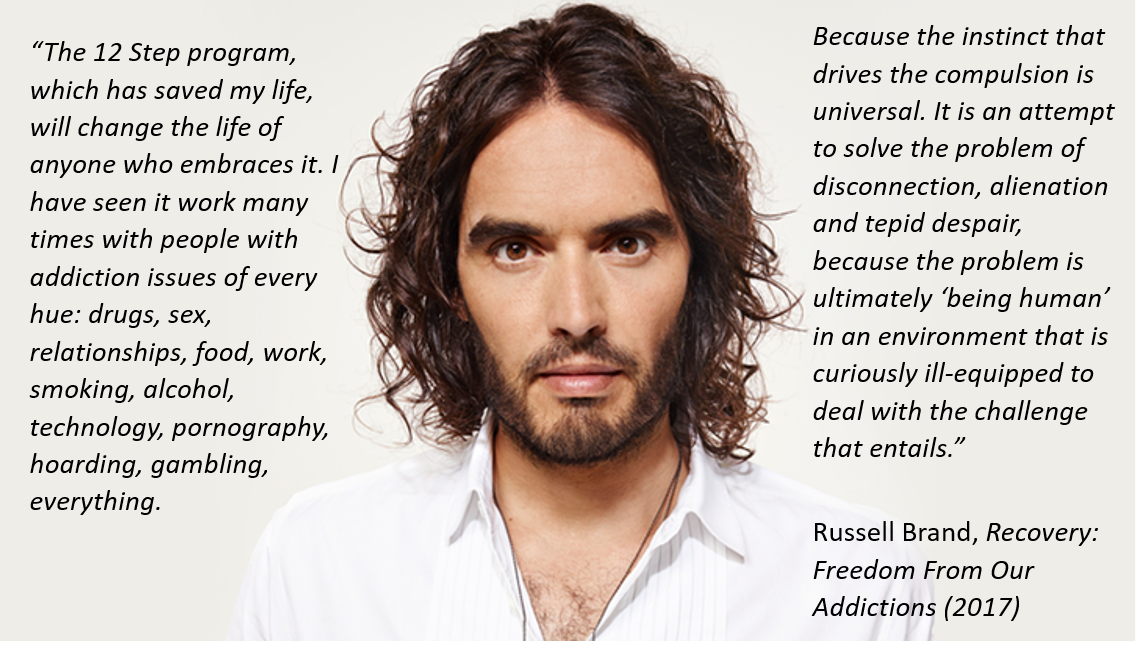
In my last job, I was based in a church building which hosted a huge range of 12 Step recovery groups in its basement.  The most famous of these is Alcoholics Anonymous (AA), but there were also groups specifically for people struggling with many of the compulsive behaviours that Brand lists above.

Disarming

In my lunchbreaks, I often attended the open AA meeting which met every day with 60-80 people present.  I had worked closely with addicts for over 20 years but the experience of participating in these meetings had a profound impact.

One initial thing I found disarming is that I have never been in any environment where there were so many references to God alongside so much swearing.  I will never forget one man saying to me after a meeting:

‘Isn’t it so f***ing good to hear these stories of salvation?’

His comment both made me laugh and struck a chord: it was great to hear such stories. 

But the theology of what he said also made me reflect. In church, we get used to hearing the word ‘salvation’ used in a purely spiritual way: often to mean the securing of God’s forgiveness and a future place in heaven.

Integrated

But the salvation referred to here was immediate, tangible, concrete. It was to do with being saved now from the corrosive effect of addiction and its deadly consequences.  It was still spiritual, but in a far more integrated way to life now.

In those meeting, I heard countless stories of people being saved from toxic behaviours which threatened their health, relationships, families, careers, future and their hope. People spoke about the gratitude they had for relationships with children and grandchildren that would have been lost if they had not found a path of recovery.

Grace & truth

What I learnt in those meetings was profoundly relevant to this blog because I don’t think I have ever been in environments which combined such a powerful blend of grace and truth.

They are places of grace because of the fundamental acceptance of people who struggle and know they need something beyond themselves. The absence of high profile leaders or didactic sermons means there is a tangible corporate humility and lack of ego. People are welcomed and their stories valued. 

But they are places of raw truth. Some of the stories could not be more honest as people share what addiction has cost them, their on-going challenges and the steps that have taken in a positive direction. There is little overblown rhetoric or cant: people speak of the challenges of today rather than lofty aspirations.

Hope

One of the co-founders of AA, Bill W, was strongly influenced by an evangelistic society called the Oxford Group.  Although he would later split from them, Wilson credited them with saving his life from his addiction to alcohol.

Although the AA movement rejected association with any particular faith or denomination, its values and practices have huge overlaps with the Christian faith.

Therefore there is much the Church can learn from the movement.  For a start, I know a number of Christians who say that the 12 Steps have been the best discipleship program they have ever experienced.

This is how Brand concludes his book about the 12 Steps:

“It has given me purpose, freed me from trauma and shame. It has given me the sanctuary that I sought from each false prophet that briefly illuminated, then stained, my using life. It has shown me that sex, drugs, fame and money are no more likely to resolve the yearning I’ve always felt than porn or biscuits.

If you feel that yearning and that you’ve never quite fitted into this world then you should give yourself and this program a chance because the yearning is real, its trying to lead you home.”

Filed Under: Sexual Purity Posts Tagged With: 12 steps, addicts, Russell Brand

  • « Go to Previous Page
  • Page 1
  • Interim pages omitted …
  • Page 132
  • Page 133
  • Page 134
  • Page 135
  • Page 136
  • Interim pages omitted …
  • Page 478
  • Go to Next Page »

Primary Sidebar

Search Site

Follow Blog via Email

Enter your email address to follow this blog and receive notifications of new posts by email.

Donate

Donate Button with Credit Cards

Helpful Links

  • Am I a Sex Addict?
  • CASTIMONIA BOOK
  • Celebrate Recovery – Houston
  • Hope & Freedom Counseling – Three Day Intensives
  • Houston Center for Christian Counseling
  • Parakaleo Women's Support Group
  • Sex Addicts Anonymous – Home
  • Sex Addicts Anonymous – Houston

Recent Posts

  • FREE Choose Connection Conference April 10-19 (Online)
  • SEVEN LAST SAYINGS: It is finished
  • SEVEN LAST SAYINGS: I am thirsty
  • How Porn Affects Church Attendance
  • SEVEN LAST SAYINGS: Woman, behold your son

Postings Archives

Categories

Footer

Useful Links

Castimonia Restoration Ministry, Inc. is a 501c3 non-profit organization


This site is intended for individuals who struggle with maintaining sexual purity. This information is posted for individuals at various stages in their recovery, year 1 to year 30+; what applies to some, may not apply others. Spouses are encouraged to read this blog with the caveat that they may not agree with, understand, or know the reason for some items posted. As always, take what you like and leave the rest.

Copyright © 2026 Castimonia Restoration Ministry